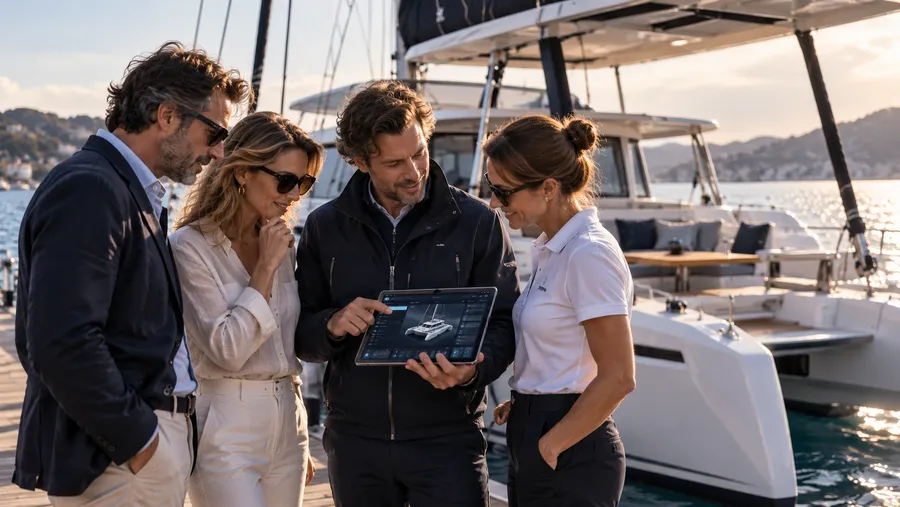
The last word stays on board.
Anyone who's spent time at sea knows this: trouble never arrives on its own, and it's almost never convenient. It comes at night, with the wind changing, while someone's asleep or busy with something else. And in that moment, someone has to decide and act quickly.
Over the last twenty years, boats have gained sensors, screens and systems. The sensors measure more than ever, but the work of joining up that data still falls to whoever has to handle the boat.
That's where we started.
We're building a layer of intelligence between the data and the person in command. It reads what's happening on board, picks out what matters, explains it in plain terms and brings it to the skipper's attention while there's still time to act. It cuts the work of interpreting. It doesn't take over the decision.
We could promise a boat that sails herself: it would make a better story, and it would sell sooner. It's not what we're building. The sea isn't a motorway, and the responsibility of whoever's in command can't be handed to an algorithm. They need to understand why the system is flagging something, and be free to disagree with it.
That's why we work on onboard processing, and on keeping functions running when there's no connection. That's why we invest in the integrity and traceability of the data. And that's why permissions are built into the architecture, not bolted on afterwards: on a private boat, that's the whole difference between a service and surveillance.
We didn't start in a lab. Digital Vessel was born inside a boatyard and proven first on the prototype we built ourselves. What we offer, we put to the test at sea first, not in a slide deck.
A boat outlives much of what surrounds her: she changes owners, crews and home ports. We believe her story should stay with her — every job, every season, every fault — in a record no one can rewrite after the fact without it showing. It's a form of respect for the boat, and for whoever owns her next.
We don't need our name on board. On the display, in the app, in the relationship with the owner, it's the people who built her or who run her who should appear. We work below decks, where good work goes unnoticed.
And we'll always say what works today and what doesn't yet. At sea, people trust whoever tells the truth about the conditions, even when they're not what was hoped for.
The technology we're building is complicated. Its purpose isn't: to leave whoever's on the helm fewer things to work out, and more time for the reason they went to sea in the first place.