

A layer of intelligence on top of the systems a boat already has.
Digital Vessel isn't designed to replace the electronics already fitted: it connects to supported systems, standardises the data and builds a layer on top that correlates it, picks out what's relevant and hands it back to people in the right context.
System architecture
Universal Hub — acquisition and control
The hub gathers data from the boat's systems, whoever made them, through the wired buses and wireless devices included in the configuration.
- Navigation: NMEA 2000 (including the SeaTalk NG and SimNet variants), NMEA 0183 and 0183-HS, NMEA OneNet and IEC 61162-450 over Ethernet; SeaTalk through a dedicated interface.
- Engines: SAE J1939, J1708 on older engines and, through the manufacturers' own gateways, proprietary engine systems.
- Power: Victron VE.Direct, VE.Can and VE.Bus, lithium battery BMS over CAN and RS-485, Modbus RTU and TCP.
- Automation and systems: CAN and CANopen, digital switching over NMEA 2000, KNX, DALI and DMX for lighting.
- Analogue sensors: 4–20 mA and 0–10 V inputs, resistive level and temperature senders to both European and US standards, pulse and digital inputs.
- Video and data: IP cameras over Ethernet, Signal K.
- Wireless: Wi-Fi, Bluetooth Low Energy, Zigbee, Thread and Matter, Z-Wave and EnOcean for systems and comfort; LoRaWAN and Wi-Fi HaLow for long-range sensors; NFC for crew tasks.
A dedicated GNSS receiver keeps position and geofencing live even with the instruments switched off. On the output side, the hub drives devices and automations through relays and PWM outputs, and every automation can always be overridden by hand by whoever's aboard. Compatibility for each protocol and device is detailed in the technical documentation.
Universal Gateway — connectivity
Pulls together data from the hubs, standardises it and picks the most suitable communication channel from those available on board.
- Terrestrial networks: 4G and 5G across multiple operators, with roaming between countries; LTE-M and NB-IoT; marina Wi-Fi.
- Broadband satellite: low-Earth-orbit constellations such as Starlink, Eutelsat OneWeb and Amazon Leo, medium-orbit networks and geostationary VSAT systems, through the terminals fitted on board.
- Narrowband satellite: L-band services such as Iridium and Inmarsat, and satellite NB-IoT, so critical alerts can get through even offshore, where there's no other coverage.
Each type of data travels on the channel that suits it: critical alerts go out on the first one available, while the full history syncs when the connection is wider and cheaper. Functions designed to run offline keep working locally and sync up once a connection's back.
Universal Intelligence — processing
The AI analyses and correlates data from the onboard sensors, feeding models and rules that detect anomalies, support maintenance and generate operational information. Some of the processing happens on board, to cut down on how much depends on a connection.
Universal Vision — user interface
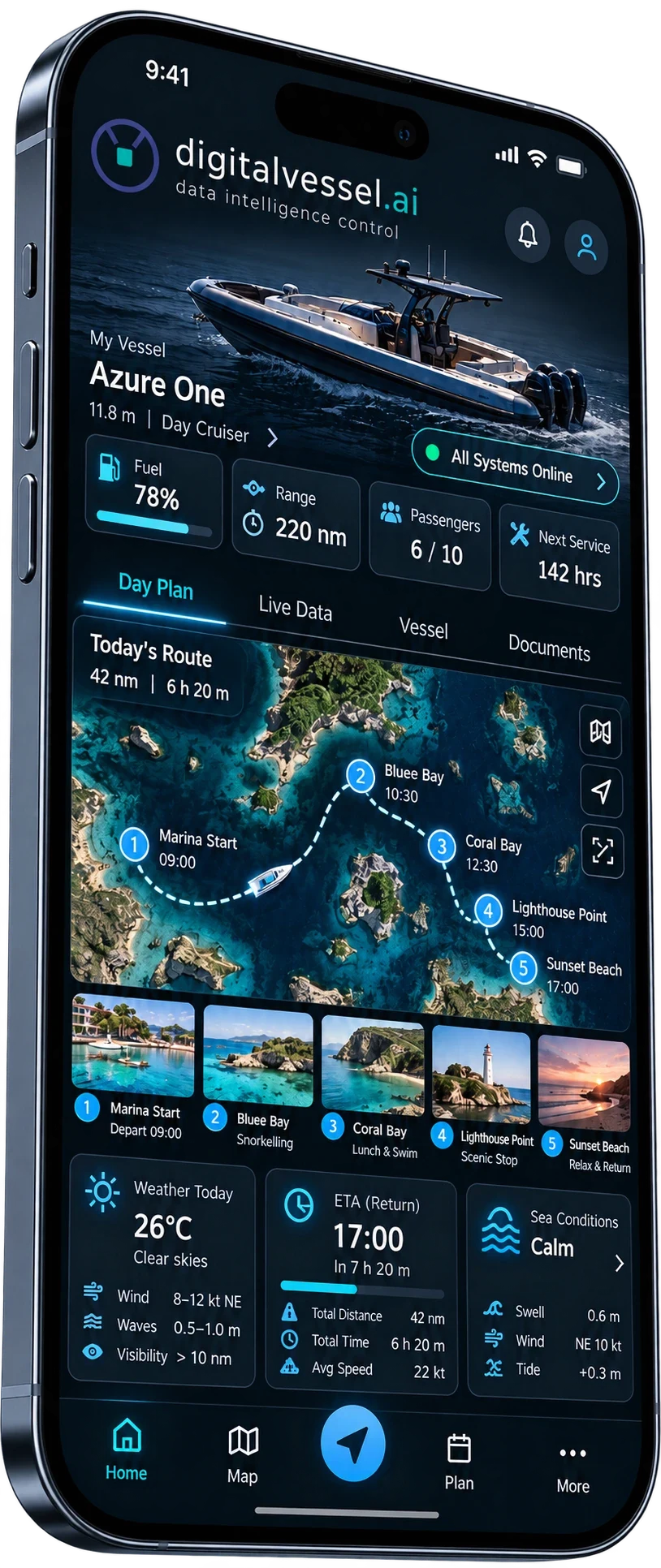
The data is presented in different viewing contexts for owner, skipper, boatbuilder, fleet manager and client, with views and permissions that match the role. On board and underway, the interface shows only what's relevant to the situation, giving the skipper a clear picture in context.
What matters has to keep working even with no signal
The architecture provides for local processing on the functions that need to stay available without a connection. The private cloud handles history, fleet-wide analysis and remote access; which functions actually run independently on board depends on the configuration and on how mature the product is.
Fits onto what's already there
The architecture is designed for both new builds and retrofit, built to make the most of the systems already aboard. Compatibility, wiring, power supply, protocols and safety requirements are checked boat by boat.
Signed data, with a verifiable trail
Data collected on board is digitally signed to support its authenticity and integrity. This makes it possible to detect any tampering and trace where the data came from, depending on the architecture in place.
Everyone sees their own patch
Access to position, telemetry, documents and personal data is organised by role and permission, and data handling is configured and documented in line with applicable law, including GDPR.
On a private boat the principle's simple: everyone sees only what they've been authorised to see. That includes, for example, the option to switch off, cabin by cabin, the presence detection described on the What's on board page.
Designed for certification
Hardware and firmware are being developed for type approval by IACS classification societies, starting with RINA, against the environmental testing (UR E10) and cyber resilience (UR E27) requirements. CE marking, including the cybersecurity requirements of the Radio Equipment Directive, and FCC certification for the US market are planned ahead of commercial release. Installations are designed to ABYC standards and to NMEA 2000 and OneNet certification requirements. Certification is a process: its actual status is kept up to date.
No boat, and no server, carries a public IP address
Security isn't a layer bolted on top of the architecture — it's part of how it was drawn up from the start.
Network isolation
Boats connect over a dedicated private cellular network; on every other channel (satellite, marina Wi-Fi), the gateway communicates only through an encrypted tunnel to Digital Vessel's private infrastructure. In no case can devices be reached from the internet, or reach it directly. No boat and no backend server exposes a public IP address.
Segmentation
Boats, yards, clients and servers each sit in their own network segment, with explicit rules on who can talk to whom. A device compromised in one segment has no access to the others.
One-way data flow
Client-facing applications read from a database replica that updates in one direction only, with no write path back to the system holding the original data.
Verified devices and updates
Every device authenticates to the network with its own identity, not shared credentials. Firmware updates are signed and verified before they're installed.
The full detail of the security architecture (segmentation, key management, logging and incident response) sits in the confidential technical pack, available on request for boatbuilders, technical partners and investors.
Technical documentation
Architecture, supported protocols, data handling and certification status are available on request for boatbuilders, fleet operators and technical partners.